- Home
- Plaine & Easie Code
Events
- online
- Wednesday, 10 December, 2025
- Thessaloniki, Greece
- 28 June, 2026
Plaine & Easie Code
This version of the code is maintained by the International Association of Music Libraries, Archives and Documentation Centres (IAML) and the Répertoire International des Sources Musicales (RISM) for use as an exchange format in the library environment. Observations or queries may be addressed to Massimo Gentili-Tedeschi or Balázs Mikusi. A tutorial is available here.
1. Clef
| G | |
| C | |
| F | |
| g |
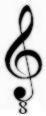
The second character is ‘-‘ to indicate modern notation or ‘+’ to indicate mensural notation.
The third character (numerals 1-5) indicates the position of the clef on the staff, starting from the bottom line.
If the music is written for a transposing instrument, notate the incipit at sounding pitch.
| G-2 | G-clef on the second line: treble (violin) clef | |
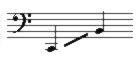
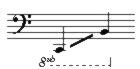
| g-2 | G-clef in the bass octave: octave treble clef | |
| C-3 | C-clef on the third line: alto (viola) clef | |
| C+3 | C-clef on the third line: alto clef in mensural notation | |
| F-4 | F-clef on the fourth line: bass clef |
2. Key signature
The symbol ‘x’ indicates sharp keys and ‘b’ flat keys. The symbol is followed by the capital letters that indicate the altered notes.
| $xFC | F and C sharp [key is D major or B minor] | ![]() |
| $bBEA | B, E, A flat [key is E-flat major or C minor] | ![]() |
3. Time signature
| 2/4 | ![]() |
| 12/16 | ![]() |
| 3 | ![]() |
| c (= common time) | ![]() |
| c3 | ![]() |
| c3/2 | ![]() |
| c/ (= alla breve, ¢) | ![]() |
| o | ![]() |
| o. (= ‘perfect’ time) | ![]() |
| 3/4 4/4 (constant change between 3/4 and 4/4) | ![]() |

4. Musical notation
4.1. Octave symbol
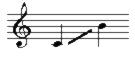
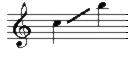
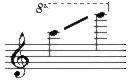
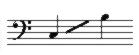
Apostrophes are used for the octaves c’ and above, while commas are used for the octaves c, and below.
| ‘ | octave c’-b’ | ![]() |
| ” | octave c”-b” | ![]() |
| ”’ | octave c”’-b”’ | ![]() |
| ”” | octave c””-b”” | ![]() |
| , | octave c,-b, | ![]() |
| ,, | octave c,,-b,, | ![]() |
| ,,, | octave c,,,-b,,, | ![]() |
4.2. Rhythmic values
| 0 | longa | |
| 9 | breve | |
| 1 | whole note / semibreve | |
| 2 | half note / minim | |
| 4 | quarter note / crotchet / semiminim | |
| 8 | eighth note / quaver / fusa | |
| 6 | 16th note / semiquaver / semifusa | |
| 3 | 32nd note / demisemiquaver | |
| 5 | 64th note / hemidemisemiquaver | |
| 7 | 128th note |
| 4. | dotted quarter-note | |
| 8.. | double-dotted eighth-note | |
| 7. | neumatic notation | |
4.3. Accidentals
| x | sharp | |
| xx | double sharp | |
| b | flat | |
| bb | double flat | |
| n | natural |
4.4. Note names
4.5. Grace notes
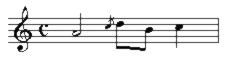
| g | acciaccatura (without rhythmic value, precedes the note name) | ![]() |
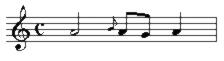
| q | appoggiatura (with rhythmic value, precedes the note name) | ![]() |
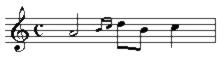
| qq…r | double appoggiatura, slide, or multiple appoggiatura (with rhythmic value) | ![]() |
4.6. Rests
| – | single-note rest (preceded by rhythmic value like note names) |
| = | measure rest (followed by number of measures and a bar line) |
| 8- | eighth-note rest | |
| 2- | half-note rest | |
| = or =1 | One measure rest | ![]() |
| =35 | 35 measures rest | ![]() |
4.7. Bar (measure) lines
| / | bar line | |
| // | double bar line | |
| //: | double bar line with repeat sign on the right | |
| :// | double bar line with repeat sign on the left | |
| ://: | double bar line with repeat sign on the left and on the right |
4.8. Other symbols
| t | trill (immediately follows the note) | |
| + | tie (immediately follows the note; only for notes of the same pitch, not for slurs) | ![]() |
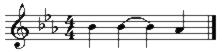
| ( ) | fermata (include only one note or rest; accidentals or octave symbols must be outside the parentheses. See also “Special rhythmic groupings” below.) |
4.9. Beaming
| { | beginning of beaming |
| } | end of beaming |
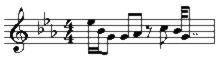
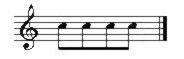
| {”6E’B8G}{GA}-”C{‘3B8..G} | ![]() |
4.10. Special rhythmic groupings
| ( | beginning of special group |
| ) | end of special group |
After ‘(‘ you must indicate the rhythmic value of the first note, even if it is equal to that of the group.
Before ‘)’ you must indicate the number of notes of the group, preceded by ‘;’.
| 4(‘6DEFGA;5) | Quintuplet, 5 16th notes, in the space of a quarter note | ![]() |
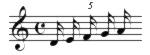
| 8({‘3DEFGA};5) | Quintuplet, 5 32nd notes, in the space of an eighth note, with beamed notes | ![]() |
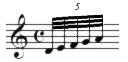
- The triplet is a special case; strictly speaking, it should be coded as follows:
- 8(6ABC;3) or 8({6ABC};3)
- Instead, the following shortcut is permitted:
- (6ABC) or ({6ABC})
- The rhythmic value inside the parentheses is required.
4.11. Shortcuts
4.11.1 Repeated figures
| ! | beginning and end of passage |
| f | repetition indication of the notes that appear within !…! |
| !{‘8ABAG}!ff | repeat twice | ![]() |
4.11.2 Repeated measures
i repeat last measure
| ‘4ABAG/i/i/ | repeat measure twice | ![]() |
4.11.3 Rhythmic sequence
| instead of {‘8.A6B”8C}{8.D6E8F} the code can be ‘8.68{AB”C}{DEF} | ![]() |
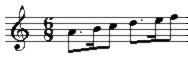
4.12. Change of clef, key signature, time signature
| %C-1$bBEA@c ‘2A-//$xFC 8B-4-2-/@3/2 1C2-// | ![]() |

4.13. Abbreviations
Notation abbreviations, such as tremolo, slash, etc., must be written out in full using the actual notation.
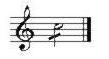
| {”8CCCC} | tremolo on C | ![]() |
= | ![]() |
4.14. Chords
| ”2D^’A^xF | ![]() |
5. Coded validity note
| ? | a mistake in the incipit has not been corrected |
| + | a mistake in the incipit has been corrected |
| t | incipit has been transcribed into modern notation |
These characters may be explained in a note (UNIMARC 036 $q — MARC21 031 $q).